
Over the Christmas holiday season I went to see A Beautiful Day in the Neighborhood. I had been eager to see it as I always enjoy Tom Hanks and had recently listened to an interview with the director Marielle Heller on Fresh Air. I didn’t grow up watching Mr. Rogers. I was more captivated by the programming on Nickelodeon as a kid.
I do think a movie like this comes along at an opportune time. There were many themes that stood out to me. Love, patience, living up to expectations, acceptance, death, empathy, processing emotions. The movie takes the form of an episode of Mister Rogers’ Neighborhood and in this episode the theme is forgiveness.

Mr. Rogers in the film defines forgiveness as “A decision we make to release a person from the feelings of anger we have at them.” He suggests that it’s sometimes hardest to forgive someone we love. This sets up the plot of the movie that follows Lloyd Vogel, a journalist working for the publication Esquire. Lloyd is married to a woman named Andrea and they have a son together named Gavin.
We learn that Lloyd has a complicated relationship with his father. He and his sister, Andrea, lost their mother at a young age. She became ill and during her illness their father was sleeping around and ultimately abandoned the family. Lorraine is getting married and has decided to reach out to her father. Lloyd’s father, Jerry, agrees to attend the wedding. This news is unsettling to Lloyd.
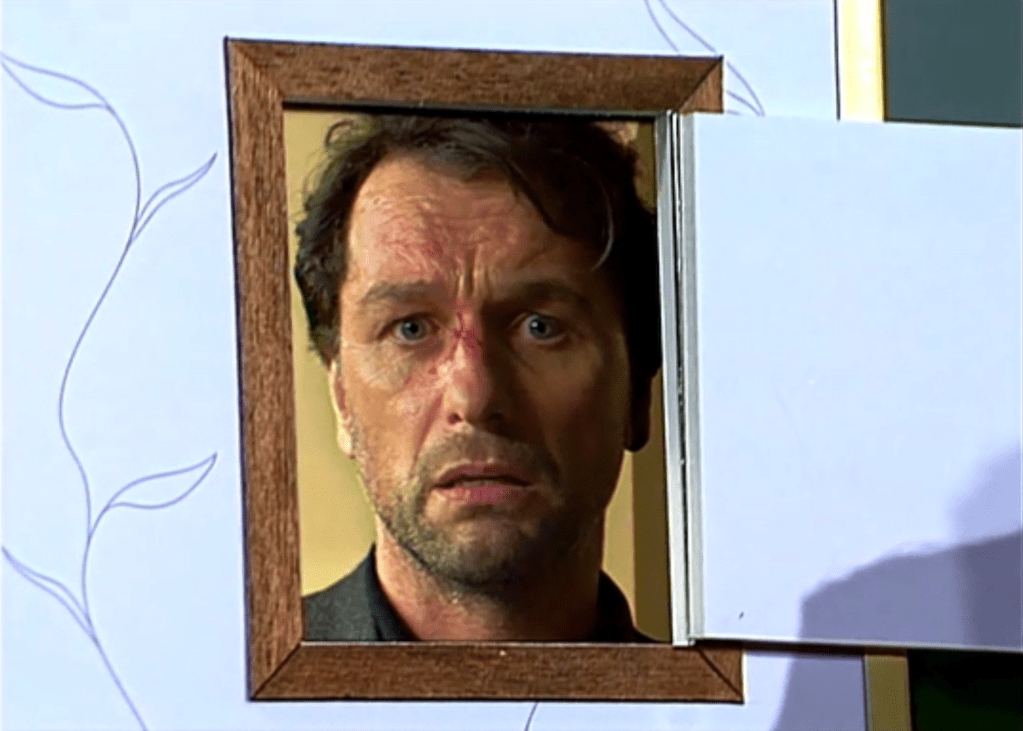
At the wedding Jerry’s behavior is charming at times, but also a bit arrogant. His pride prevents him from confronting his past actions and the pain that he caused his family. The scene at the wedding culminates with an argument between Lloyd and Jerry, resulting in Lloyd punching his father, and a guest at the wedding punching Lloyd in the face. Lloyd’s battered face is how Mr. Rogers introduces his audience to him.
Lloyd crosses paths with Mr. Rogers as part of an assignment. Esquire is doing a piece on heroes and Lloyd has been selected to write a profile on Fred Rogers. We find out Lloyd has a reputation for publishing unflattering pieces about the people he interviews. The role of a journalist in his mind is to “expose truth others cannot see”. Lloyd’s character comes across as a bit cynical. He is weary of people. He knows how painful life can be and is on guard for more of life’s suffering.
Lloyd’s first interaction with Mr. Rogers is on the telephone. Mr. Rogers explains that what his show is trying to offer to kids is, “Being fully present to their feelings and their needs.” He then tells Lloyd, “Do you know what the most important thing is to me right now? Talking on the telephone to Lloyd Vogel.”
My interest in meditation has led me to learn a lot about Buddhism. Although I would not call myself a Buddhist, I find the philosophy behind much of it to be incredibly helpful in my life. Perhaps my recent interest in Buddhism colors my analysis of the Mr. Rogers character depicted in the movie. Mr. Rogers did not come to any conversation with an agenda. He is a careful listener with a high degree of intuition. He is present. A subsequent phone call by Mr. Rogers to the Vogel residence is answered by Andrea. Andrea is fond of Mr. Rogers from watching his show as a child and is a bit flustered when she realizes she is talking to him. She quickly attempts to hand the phone over to Lloyd, but Mr. Rogers takes the opportunity to tell Andrea, “I just want to thank you for sharing Lloyd with us. It can’t be easy with him traveling with Gavin at home.” Mr. Rogers couldn’t know that he would be speaking with Andrea, but finding himself with that opportunity he gives her his full attention and shows empathy towards her.
Lloyd visits Mr. Rogers on the set of his show. When they have the opportunity to sit down and talk Mr. Rogers explains that the aim of the show is, “Trying to give children positive things to do with their feelings.” The conversation quickly turns to Lloyd’s face, which he claimed earlier was from a softball injury. Mr. Rogers calls this explanation into question. Lloyd admits he has been in a fight. Mr. Rogers is surprised by this information and grows even more concerned when Lloyd hesitantly admits the fight was with his father.
A later interaction between Lloyd and Mr. Rogers takes place at Mr. Rogers’ apartment in New York City. Mr. Rogers begins introducing Lloyd to his puppet friends. Mr. Rogers attempts to bring out a childlike innocence and vulnerability in him when introducing him to Daniel Striped Tiger. Lloyd is unwilling to play along. “Well, maybe Lloyd doesn’t feel like talking today. And that’s okay.” Mr. Rogers believes talking is the only way to work through feelings. Mr. Rogers is seen saying in an old television clip, “I don’t think anybody can grow unless he really is accepted exactly as he is.” Mr. Rogers seems to advocate for surrender. To stop fighting feelings. To stop fighting what the world throws at you. To accept life for what it is and to not be ashamed of your feelings.
Lloyd returns home to a surprise guest. His father has stopped by with his girlfriend, Dorothy. Lloyd does not welcome this situation. Lloyd takes a hardline against his father telling him how terrible it was to be abandoned and for him and his sister to be solely responsible for handling the death of their mother. Jerry becomes emotional and then suffers an episode that leads to his collapse. It’s now clear that Jerry has been reaching out, because he is coming to the end of his life due to a heart condition.
Instead of staying at the hospital with his father, Lloyd heads to Pittsburg to visit Mr. Rogers again on the set of his show. Upon arriving Lloyd himself collapses. Mr. Rogers brings Lloyd to his home to rest and upon waking up takes him to lunch. Before beginning eating Mr. Rogers asks Lloyd to, “Take a minute and think about all the people that loved us into being.” Lloyd views himself as a broken person, but Mr. Rogers does not. It’s at this moment that Lloyd seems to decide that he wants to be a better father to Gavin and part of that process will require him forgiving his father.
Lloyd goes to Jerry’s home to spend time with him in his final days. Lloyd begins to soften towards him. Jerry finally apologizes to Lloyd and tells him he always loved him. Jerry laments, “It’s not fair, you know. I think I’m just now starting to figure out how to live my life.”
It’s absurd how most of us live our lives. We all know that we will one day die, but our actions in the present rarely reflect this fact. So much time is spent giving attention to things that will be utterly meaningless when we are dead. The possessions we seek. The approval of others that we crave. The opportunities we pass up for fear of failure. Our time is so preciously short and what little time we do have is spent in a dreamlike state, chasing things that even if captured will only lead to more chasing.
In one of the final scenes Lloyd, Andrea, and Gavin are at Jerry’s house and Lorraine arrives with her new husband, Todd. A final guest, Mr. Rogers arrives with freshly baked pie in hand. They sit around Jerry’s hospital bed in the living room talking and joking. Jerry alludes to the little time he has left on this earth. The group becomes silent. After some time Mr. Rogers offers, “You know death is something many of us are uncomfortable speaking about. But to die is to be human. And anything human is mentionable. And anything mentionable is manageable.”
There isn’t much willingness for the average person to be vulnerable. I struggle to be emotionally honest and share even with those closest to me how I truly feel. It is scary to let my guard down and admit out loud my personal fears and anxieties. To say them out loud is to make them all the more real. But this is the absurdity that I mentioned. We live in denial all in an effort to shield ourselves from the uncomfortable aspects of life. The desire to protect yourself is completely natural, but to do so at the expense of being fully available to the people that you care about most is to miss the most beautiful parts of life. It’s a futile effort to spare yourself the inescapable pain that is intrinsic to the human experience.
At the start of the movie we meet Lloyd with a battered face. By the end of the movie we find him transformed into a more open and loving person.

I’m not sure I would have wanted to reestablish a relationship with a father that acted the way Lloyd’s did. I think forgiveness can be given while still having boundaries that protect us from destructive people in our lives. Each person must decide for themselves who they want to have in their life and the quality of those relationships. The main message I took from this movie was that our time is tragically short. Instead of holding onto feelings of hurt and anger, we should be brave and do what we need to in order to process our feelings. It’s the only way to make room for love in our heart and to experience joy in our lives.
“There’s no one in the whole world like you and I like you just the way you are.”
 Mike Urell