
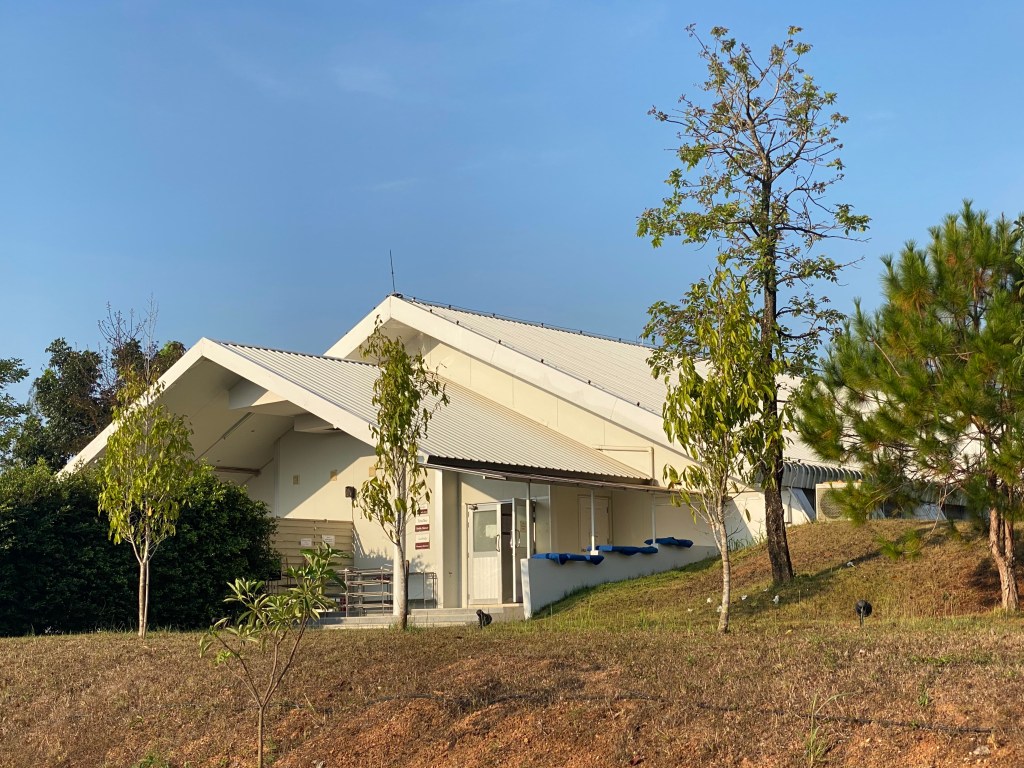
I awoke to a buzzing noise. It was the morning of Day 3. We lost power yesterday evening. Was this a sign the power was back on? What time was it? 5:50 am. I was supposed to be up at 4. I was so tired I didn’t care. I’ll try to sleep through the buzzing, I thought. Then at 6 am the chanting started. Goenka’s chanting in Poli was being piped through the PA. Did he know I had been sleeping instead of meditating? Can he see me right now? Will I ever be allowed to leave this place?
Wait… what?
Great question. What the hell was I doing there? If my former self could only have seen me then.
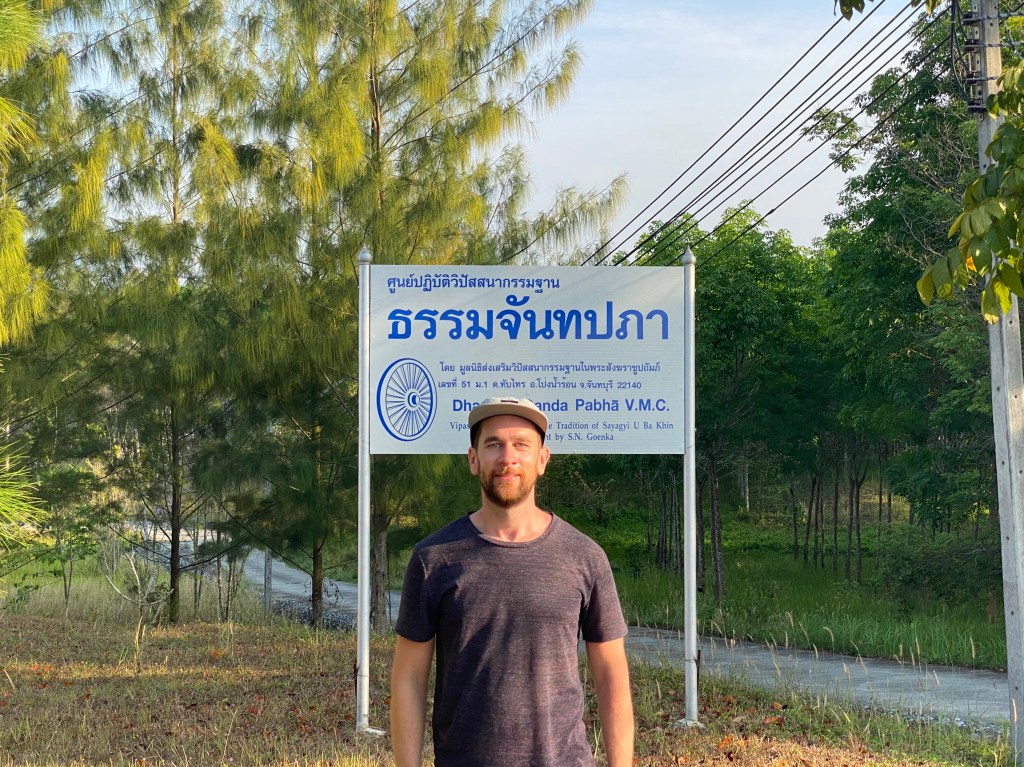
I was on a 10 day silent Vipassana retreat at the Chantaburi Vipassana Centre in eastern Thailand. This was to be one of the major highlights of my sabbatical. A lifetime skeptic of mediation and all things Buddhist, I finally gave meditation a shot and began meditating regularly starting in December 2018. As I learned more about meditation I came to learn that 10 day retreats were considered a vital experience to progress in one’s practice.
A 10 day course consumes roughly 12 days as Day 0 is spent arriving at the center, checking in, orientation, and the first group meditation. Days 1 – 10 are spent sleeping, eating, meditating, and staring at the wall. Day 11 is spent having breakfast and traveling back from the center. Some people travel from far away to attend a retreat, so taking two weeks for an experience like this is common. If you’re employed, this amount of time puts you in a position where you must choose between a two week vacation, perhaps on a sandy beach sipping on cocktails, or 10 hours a day meditating in humble accommodations. Since I had 11 months to work with it was an easy decision to carve out some time for this experience.
Ok, sure. But, why?
Well, ok, fair enough. Let me back up some more.
Give this exercise a shot. Find a comfortable place to sit upright. Set a timer for one minute. Close your eyes and for the entire minute just notice your breath. You might notice your breathing most in the sensation of air passing through your nostrils, or maybe your chest rising and falling. Wherever you experience the breath most clearly, put your focus there and nowhere else. Go ahead, I’ll wait right here.
***
When I first did this exercise, it was surprising to me that I was unable to focus solely on my breath for a sustained period of time. I’d get a second or two in and I’d drift off in thought, only to realize many moments later what had happened. What was interesting to me was the realization that I wasn’t consciously creating my next thought. Thoughts seemed to just appear.
Strengthening my resolve to do nothing but focus on my breath did little to hand the reins back over to my own free will and choose my next thoughts. Instead of fighting these thoughts and trying to clear my mind of them, I instead learned to observe my thoughts like a spectator in a crowd. When a thought popped up, instead of immediately identifying with it and letting it carry me away, I simply acknowledged its presence.
This exercise broke a cycle I had been in my whole life. I hadn’t even known I was in a cycle, before I broke it. The cycle I mention was contemplation of my past or anticipation of my future. A constant replay of previous emotional wounds, moments of happiness I couldn’t experience again, and fears of what the future might bring. Thoughts of the past and future pop up in my brain constantly and carry me away from the present moment. What I had stumbled upon, through meditation, was a technique for breaking the spell of rumination and to return to the present moment and the world around me.
What’s so special about the present moment?
Being in the present moment can be the difference between hearing and listening to someone. When engrossed in a task and someone interrupts you it can be the difference between lashing out and greeting them with a warm smile. Through the practice of meditation I discovered layer upon layer of thoughts, insecurities, and fears that only served to distract my mind. In pulling back those layers I found myself available to the people around me in a way that has led to deeper connections, richer experiences, and greater empathy.
What is Vipassana Meditation?
The center describes it this way:
Vipassana is one of India’s most ancient meditation techniques. Long lost to humanity, it was rediscovered by Gotama the Buddha more than 2500 years ago. Vipassana means seeing things as they really are. It is the process of self-purification by self-observation. One begins by observing the natural breath to concentrate the mind. With a sharpened awareness one proceeds to observe the changing nature of body and mind and experiences the universal truths of impermanence, suffering and egolessness. This truth-realization by direct experience is the process of purification. The entire path (Dhamma) is a universal remedy for universal problems and has nothing to do with any organized religion or sectarianism. For this reason, it can be freely practiced by everyone, at anytime, in any place, without conflict due to race, community or religion, and it will prove equally beneficial to one and all.
Preparation
To attend a retreat like this it’s actually pretty straightforward. First consider the time of year and the destinations you’re willing to travel to for the retreat. Then head over to http://dhamma.org. This site includes a directory of centers around the world that all conform to the same methods and standards established by the Vipassana teacher S.N. Goenka.
You’ll need to plan at least a few months in advance. Most centers receive more requests to attend courses than they can accommodate. There is a waitlist option, but it’s best to set your calendar to remind you the day registration opens and get your application in that day.
The application is quite short. Aside from collecting some basic personal info at the start, some more personal questions are asked in an effort to screen out people who might not be well suited to undergo an intensive retreat such as this one. People on medications used to treat mental disorders, those seeking to treat psychological issues through mediation, and those with a history of drug abuse are reviewed carefully in the interest of the safety of the potential participant and the others attending the retreat.
After submitting my application I received a response within a couple weeks.
Experience
The schedule I kept during the retreat was the most regimented I’ve had since I was in school:
4:00 a.m. Morning wake-up bell
4:30-6:30 a.m. Meditate in the hall or in your room
6:30-8:00 a.m. Breakfast break
8:00-9:00 a.m. Group meditation in the hall
9:00-11:00 a.m. Meditate in the hall or in your room
11:00-12:00 p.m. Lunch break
12:00-1:00 p.m. Rest, and interviews with the teacher
1:00-2:30 p.m. Meditate in the hall or in your room
2:30-3:30 p.m. Group meditation in the hall
3:30-5:00 p.m. Meditate in the hall or in your room
5:00-6:00 p.m. Tea break
6:00-7:00 p.m. Group meditation in the hall
7:00-8:15 p.m. Teacher’s Discourse in the hall
8:15-9:00 p.m. Group meditation in the hall
9:00-9:30 p.m. Question time in the hall
9:30 p.m. Retire to your room
10:00 p.m. Lights out
It took some getting used to, to say the least. One of the stranger aspects of the experience was passing people at the center and not greeting them or even making eye contact. The practice of “Noble Silence” made me feel like a sociopath. That feeling slowly dissipated as I settled into the notion that my silence was to aid the others around me in their practice.
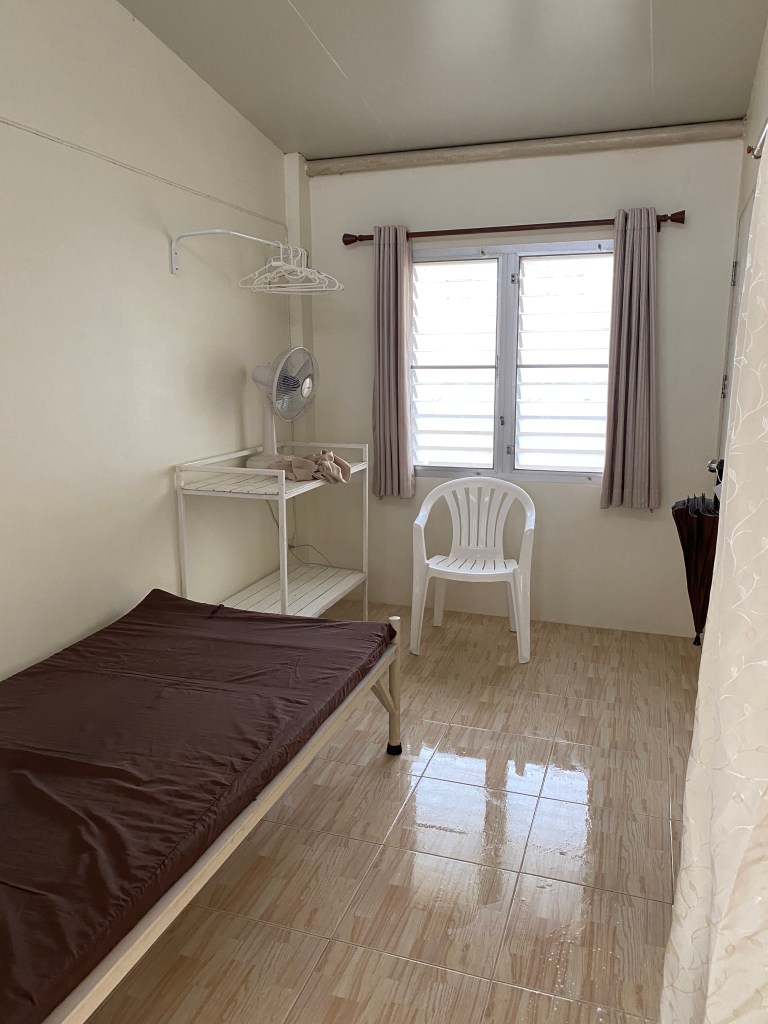
The center offered each student a private room with ensuite bathroom. It was humble, but comfortable. The mattress was a thin mat laid on an elevated wooden platform. At times I found it hard to sleep. This led me to consider just how much I take for granted in my life. Bringing your own food or holding currency or any means of payment while at the center is not allowed. I lived as a beggar, relying on the charity of previous students who had completed a 10 day retreat.
This is one aspect I appreciated very much. Attending a retreat costs nothing and only those who completed the 10 day course are invited to make a donation, large, or small. It warmed my heart to know that my stay there was provided by students much like myself that had benefited from participating at a retreat. It made me even more glad to pay that generosity forward at the end of my retreat.
Meals were buffet style with chairs and small eating surfaces facing windows or walls. The food was quite good. The vegetarian dishes were varied and all cooked at an adjacent building. Some of the best food I had while in Thailand was at the center. Participants fast in the evening, but new students could have a dinner amounting to tea and peanut butter sandwiches. I was able to adjust to this quickly. I never felt too hungry and my mind felt concentrated throughout the day.
A dedicated meditation hall is where each meditation session takes place. The hall is split with men on one side and women on the other. Meditation cushions are arranged in rows, with each cushion numbered. At the start of the course you are assigned a cushion and you maintain that cushion throughout the course.
There was some protocol to follow inside the hall. No water bottles. No shoes. No yoga/stretching. No moving of cushions, or switching out a cushion for a chair without the permission of the teacher. No pointing your feet in the direction of the assistant teacher. For the uninitiated, like myself, I didn’t know what to make of all the protocol. It felt vaguely like being in church. My takeaway after sitting the retreat was that the hall was meant to be as free of distractions as possible, so that you could focus solely on meditation.
The instructions for meditation and gentle guidance during the meditations were given through recordings from previous sessions taught by Goenka. This felt natural to me as I had learned to meditate through recorded guided meditations. The assistant teacher was on hand to offer guidance and answer questions, but instruction was completely left up to the recordings of Goenka.
The group sitting the retreat with me was made up mostly of women. One explanation I was given for this is that women are not allowed in Thai culture to join a Buddhist monastery. A retreat center like this is one of the few options a woman has to deeply practice meditation with others.
We were 15 men. 7 left over the course of the 10 days. The protocol of not moving cushions in the hall until the final meditation of the day would make it obvious when someone left. Their cushion sat there like a corpse, waiting to be carried out under the cover of night.
Why people leave is something I can only speculate about. Practicing noble silence does not allow the opportunity to understand the struggles of others. There were people I looked forward to speaking with after the retreat was over, but they disappeared without a word. Their empty rooms made me question if they ever existed.
Before the final meditation and giving of instructions for the following day, we would assemble for a “Dhamma Talk”, or “TV time” as I called it in my head. These talks were video lectures given by Goenka. They’re available to watch on YouTube. They are about an hour long and provide support in understanding the meditation practice. I wasn’t sure what to make of Goenka at first, but after watching several of his talks he won me over.
Reintegration
The morning of the 11th day I went to my locker and took out my phone, wallet, computer, and journal. The glow of my phone made me feel at once excited and filled with dread. Messages poured in. I screened the headlines. Was the world where I left it? Was everyone I loved ok? If there had been an emergency I would have been given a message from the center, so much of my fear was irrational. My first phone call was to my mother. It filled my heart with joy to hear her voice and to know her and my dad were well. It was a humbling moment for me when it set in how little my absence from the world had affected it in the grand scheme.
When I relate to the world, it is always with me at the center of the experience. Things happen to me. My eyes are the camera that zooms in and gives attention to what is around me. The world bends and moves based on my actions. Putting my life on pause for 10 days and then hitting the play button again broke that illusion.
The long car ride back to Bangkok passed quickly. It was unsettling to find myself in a city throbbing with energy. People talking on phones, cars buzzing by, cramming myself into train cars. Though I’ll never tire of the electric feeling I get from being in a vibrant metropolis, I returned to Bangkok with a weariness. I felt in that moment awake and present. I did not want to be carried away once again and live life in a dreamlike state.
What’s Next
Goenka recommends several things for students who want to continue in their meditation practice. Meditate one hour in the morning and one hour in the evening each day. Attend a 10 day retreat at least once a year. Volunteer at a 10 day retreat once a year.
I’ll be volunteering for a 10 day retreat at the Dhamma Sobhana Centre in central Sweden starting next week. Acting as a server is considered part of your development in mediation practice. It is not a form of payment for lodging and food.
Do Try This At Home
A 10 day retreat is a large commitment. Simply introducing meditation practice into your daily life is hard enough. For me, it all began with the Ten Percent Happier app. The courses The Basics and The Basics II with Joseph Goldstein started me down a path that has led to meditation being a daily part of my life and a completely new way of viewing myself and the world around me.
A book I can recommend is The Art of Living. It is written by William Hart, who sat for courses conducted by Goenka. He wrote the book in collaboration with him. The audiobook is great as the quoted text of Goenka is presented as recordings of him speaking at previous retreats.
Wishing you way more than luck.
 Mike Urell